Advanced Analytics for Rail Yard Safety & Near-Miss Detection
Beyond Accident Statistics: The Value of Near-Miss Data
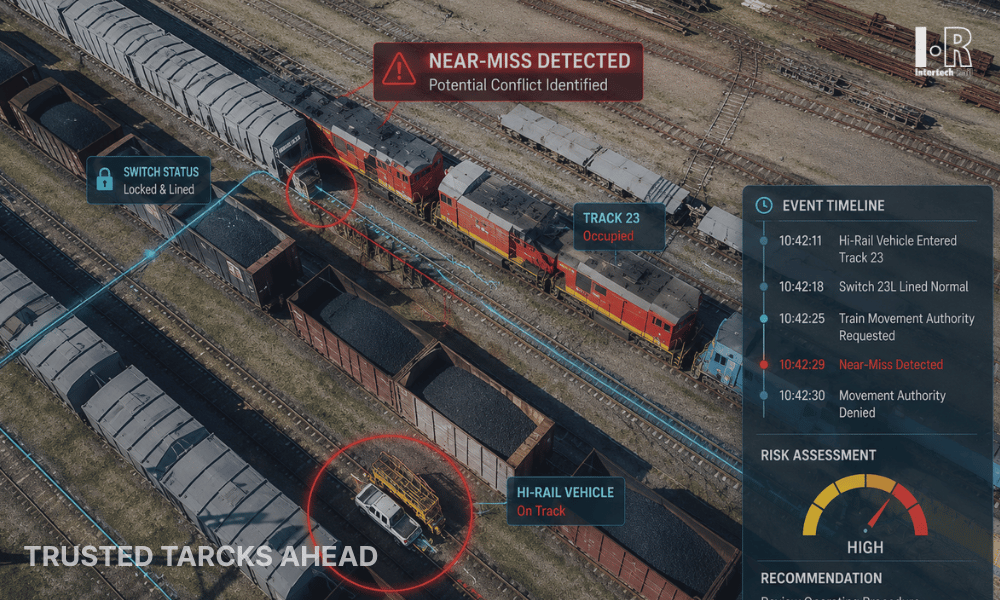
Accidents are only part of the safety picture in a rail yard. Every day, small operational issues happen that never become reportable incidents. A switch is found in the wrong position before a movement starts. A crew pauses to clarify an instruction. A train stops unexpectedly while the situation is checked.
Operations continue as planned, and the event is soon forgotten.
Even so, these situations are worth recording. Over time, they help show where procedures, communication, or daily operations are creating unnecessary risk. Near-miss detection data makes those recurring situations easier to identify.
What Is a Safety Near-Miss in a Rail Yard Context?
Unsafe Movements That Do Not Result in an Accident
A near-miss is an event where normal operations come close to an accident but recover before any damage or injury occurs.
The movement is completed, nobody gets hurt, and service continues. Looking back, however, it is clear that something prevented the situation from getting worse.
Conflicts Between Equipment, People, and Trains
Examples are easy to find in most rail yards. A maintenance vehicle enters a track that is about to be used. A switch is corrected during the final check before movement authority is given. Two crews prepare for conflicting movements without realizing it immediately.
Each event may seem isolated, but repeated occurrences usually point to the same operational weakness.
Why Are Near-Misses Often Underreported?
Lack of Formal Reporting Mechanisms
Many organizations still document only events that interrupt operations or produce measurable losses. As a result, valuable operational information never reaches the safety database.
Cultural Barriers and Fear of Blame
Reporting also depends on trust. If employees believe every report will become a search for individual responsibility, many close calls remain informal conversations instead of useful safety records.
Using Yard Data to Detect Safety Risks
Modern rail yard analytics brings together switch logs, dispatch records, train movements, occupancy information, and equipment status. Looking at these datasets together often reveals relationships that remain invisible when each system is reviewed independently.
What Yard Events Can Indicate Potential Near-Misses?
Last-Minute Switch Changes Before Train Movement
A switch that repeatedly requires correction immediately before a scheduled movement deserves investigation. The issue may involve field procedures, dispatcher workload, communication between crews, or something as simple as the sequence in which movements are being planned.
Repeated Emergency Stops in Certain Tracks
An occasional emergency stop may have a straightforward explanation. Seeing similar braking events return to the same area over multiple shifts is different. That kind of repetition usually indicates an operational condition worth examining more closely.
How Can Analytics Highlight High-Risk Patterns?
Clustering Incidents by Time, Location, and Train Type
One event rarely explains much on its own. Fifty events occurring on the night shift, around the same ladder track, or involving similar train movements begin to describe a trend that deserves engineering attention.
Correlating Workload Peaks with Safety Deviations
Busy operating periods change the rhythm of a yard. Crews rotate, maintenance activities overlap with train movements, and dispatchers make more decisions within shorter periods. Reviewing predictive analytics alongside those operating conditions often explains why specific deviations appear more frequently during certain windows.
GO DEEPER ON THESE TRACKS: Improving rail yard safety depends on reliable operational data, proactive maintenance, and continuous performance monitoring. Explore What Is Rail Yard Performance Management? The Complete Guide to Turning Yard Data into Operational Results to learn how performance metrics reveal operational trends, discover What Is Condition-Based Maintenance in Railway Signaling? A Practical Guide to Reducing Unplanned Failures for strategies that reduce equipment failures before they occur, and review How Can Railroads Use Yard Data to Provide Real-Time Customer Visibility Portals? to understand how accurate operational information benefits both safety and customer communication. These related articles are already published or will be available soon.
Turning Insights into Safety Improvements
Collecting operational data has little value if it never influences the way the yard operates.
What Actions Can Operators Take Based on Data?
Adjusting Procedures for High-Risk Movements
Sometimes the findings support a procedural change. In other cases, they point to a confusing operating sequence, a location where visibility is consistently limited, or an instruction interpreted differently from one crew to another. The objective is not to add more rules but to remove recurring sources of uncertainty.
Targeted Training and Supervision in Critical Zones
The same principle applies to training. Rail safety analytics helps identify where additional coaching will have the greatest impact instead of applying the same level of attention across every part of the yard.
How Should Safety Analytics Be Communicated?
Clear Dashboards for Safety Teams and Management
Good dashboards help people see recurring issues instead of isolated events. When the same type of situation keeps appearing in one area, during one shift, or under similar operating conditions, supervisors know where to focus their attention before a reportable incident occurs.
Regular Review of Safety KPIs Including Near-Misses
Traditional accident metrics remain essential, but they should not stand alone. Reviewing near-miss frequency, emergency braking locations, repeated switch corrections, and movement conflicts provides a broader understanding of everyday yard performance. In practice, those indicators often reveal where improvements are needed long before the first reportable accident confirms the problem.
What is Asset Visibility, and how does it work?
Asset visibility refers to the ability to monitor the location, condition, status, and utilization of physical assets across an operation. In rail environments, this includes rolling stock, maintenance equipment, containers, and other critical resources. Data is gathered automatically and consolidated into systems that provide a unified operational view.
Why is Asset Visibility important for modern railway operations, and what challenges can it solve, and what benefits does it provide?
Without reliable asset visibility, organizations often struggle with asset utilization, inventory control, and operational planning. Improved visibility helps reduce uncertainty, improve resource allocation, support maintenance activities, and provide stakeholders with accurate information about asset availability and operational status.
What technologies are commonly associated with Asset Visibility?
Asset visibility programs often combine RFID, AEI, GPS tracking, condition monitoring systems, IoT sensors, enterprise software, analytics platforms, and operational dashboards. Integrating multiple data sources allows organizations to gain a more complete understanding of asset performance and utilization.
What Intertech Rail solutions are available for Asset Visibility?
Intertech Rail provides identification, tracking, and data management solutions that support asset visibility initiatives. Through the Rail-ID® ecosystem, operators can capture movement events, maintain asset records, and improve access to operational data across railway networks and facilities.
Share article