How Do Fail-Safe Relays Prevent Train Accidents? Understanding the Safety Logic Behind Rail Signaling
The Connection Between Relay Failures and Train Accidents
What Types of Accidents Can Signal Relay Failures Cause?
Rear-End Collisions from False-Clear Signal Aspects
In railway signaling, the most dangerous failure is not usually the one that stops trains. It is the one that incorrectly allows movement.
A false-clear signal can place two trains into the same block section without the crew realizing anything is wrong. Historically, several serious rail accidents started with exactly that type of condition. A relay contact welded shut. A circuit failed to drop properly. A signal displayed proceed when it should have remained at stop.
That is why the entire philosophy behind Signal relay safety logic is built around restriction by default.
Head-On Collisions from Incorrect Route Setting
Inside a busy interlocking, multiple train movements may compete for the same physical space. Without proper locking logic, conflicting routes could theoretically clear at the same time.
A properly designed Relay interlocking safety system physically prevents this from happening. The circuits are arranged so one route locks out another before the signal can display proceed authority.
It is old technology in some ways. But still remarkably effective.
How Common Are Signal-Related Accidents?
The Human and Economic Cost of Signal-Related Incidents
Modern signaling systems have reduced accident rates significantly compared to earlier generations of railway operation. Even so, signal failures still receive enormous attention across the industry because the consequences can escalate quickly.
And the effects are rarely limited to equipment damage alone.
A serious signaling incident can interrupt freight corridors for days, damage infrastructure, delay passenger operations across an entire region, and place train crews in immediate danger. In practice, railways would rather accept nuisance delays than tolerate unsafe proceed conditions.
That tradeoff sits at the center of Train signaling safety system philosophy.
Why Is the Fail-Safe Principle So Effective at Preventing Accidents?
The Logic of When in Doubt, Stop the Train
Railway engineers often simplify the fail-safe principle into one sentence: when in doubt, stop the train.
That mindset influences everything inside a signaling circuit. If power disappears, if a wire breaks, if voltage falls outside acceptable limits, or if a relay behaves unexpectedly, the system responds conservatively.
This is exactly how a fail-safe relay prevents accidents in real operation.
The relay de-energizes. The signal returns to stop. Route locking remains applied. Train movement becomes restricted until the condition is inspected and verified.
Importantly, fail-safe systems are designed to avoid dangerous failures even if that means creating operational inconvenience. A delayed train is acceptable. An unsafe proceed indication is not.
The Safety Logic of Relay-Based Signaling
How Does a Relay Interlocking Prevent Conflicting Movements?
The Concept of Mutual Exclusion in Relay Logic
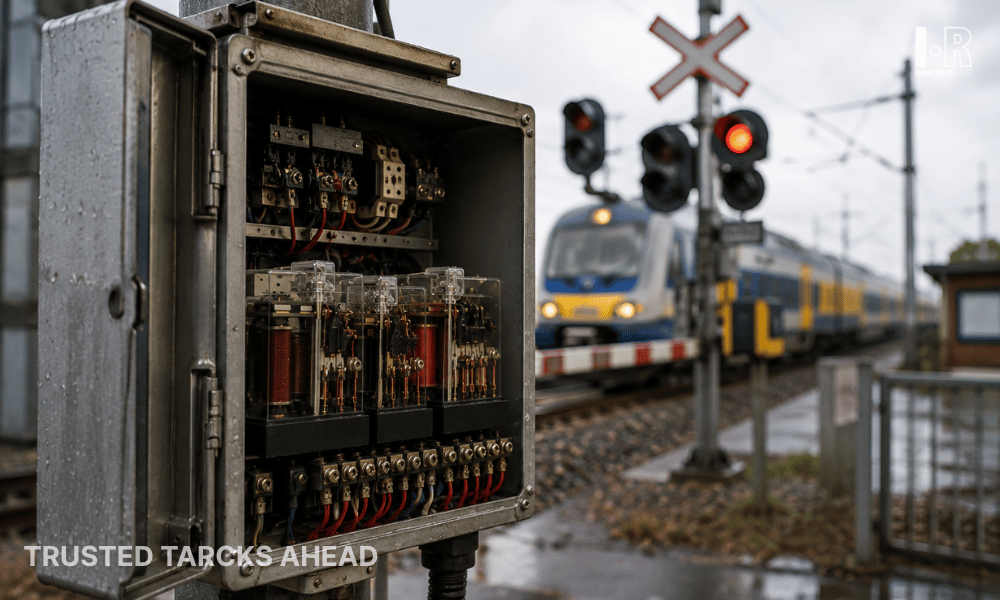
Inside a relay interlocking, electrical circuits continuously check route conditions before movement authority is granted.
Switch positions must be proven. Track circuits must show unoccupied sections. Conflicting routes must remain locked out. Only after every condition is verified can the signal clear.
This process happens extremely fast, but the logic itself is surprisingly physical. Contacts open and close in carefully arranged sequences that physically prevent unsafe combinations.
That mechanical certainty is one reason many railways still maintain relay logic as part of their vital infrastructure.
How Does Fail-Safe Design Handle Multiple Simultaneous Failures?
Defense in Depth for Railway Safety
Rail signaling does not rely on a single layer of protection.
Modern systems combine relays, track circuits, locking logic, monitoring systems, procedural rules, and human verification into overlapping safety layers.
Engineers often refer to this as defense in depth.
Because of that philosophy, one abnormal condition usually triggers several independent restrictions at the same time.
And in railway signaling, that is exactly the point.
GO DEEPER ON THESE TRACKS: Learn the fundamentals in What Are Fail-Safe Relays? The Complete Guide to Safety-Critical Switching Technology in Rail Signaling, explore maintenance strategies in Fail-Safe Relay Maintenance: How Often Should You Inspect, Test, and Replace Safety-Critical Relays?, and compares technologies in Fail-Safe Relay vs. Solid-State Safety Relay: Which Technology Should You Choose for Your Signaling Application? These related articles are already published or will be available soon.
Share article