What Are Fail-Safe Relays? The Complete Guide to Safety-Critical Switching Technology in Rail Signaling
Understanding Fail-Safe Relays
What Is a Relay and What Does It Do in a Signaling System?
The Basic Function of an Electromechanical Relay
Anyone who has spent time inside an older signal bungalow knows the sound. Relays clicking in sequence. Contacts lifting and dropping. A low mechanical hum mixed with the occasional sharp snap of a track relay changing state.
Railway signaling used to be something you could almost follow by ear.
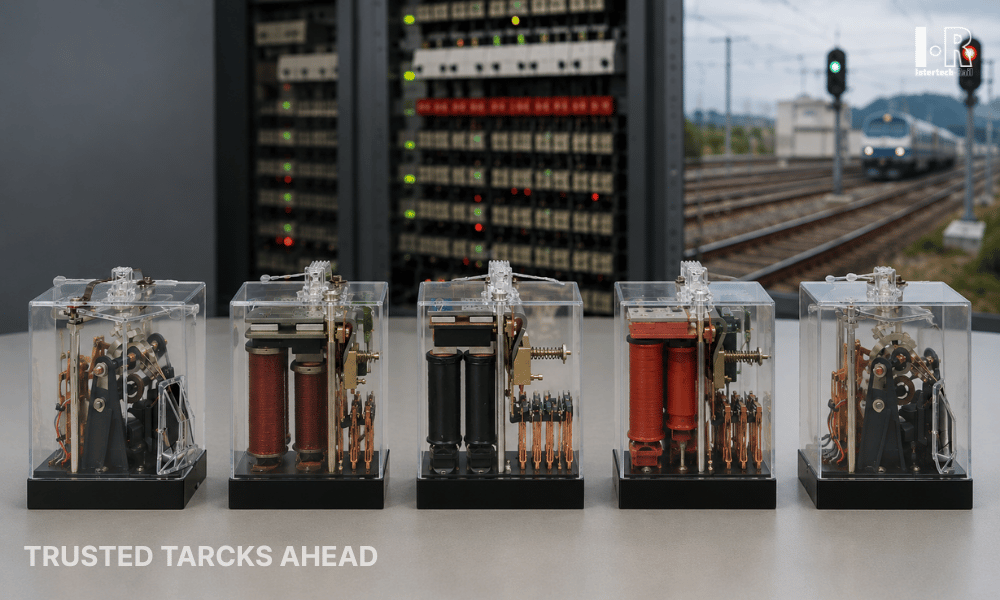
Before explaining what a fail-safe relay is, it helps to start with the relay itself. In simple terms, a relay is an electrically operated switch. A small control current energizes a coil, creating a magnetic force that moves an armature and changes electrical contacts from one position to another.
It sounds basic. In practice, it controls critical railway functions every second of the day.
In traditional Electromechanical relay signaling, relays supervise signal indications, switch detection, route locking, and track occupancy logic. One contact opening or closing at the wrong time can affect an entire interlocking plant.
That is exactly why railways became so strict about relay behavior.
Even now, with processor-based interlockings becoming standard across many networks, physical relays still remain part of vital systems. Engineers trust them because their operation is visible. You can inspect contact wear. You can measure pickup values. If something starts behaving abnormally, experienced maintainers usually notice it quickly.
Sometimes, before a failure actually occurs.
What Makes a Relay Fail-Safe?
The Core Principle Behind Fail-Safe Design
A Fail-safe relay railway signaling system is designed around one very important rule: if something fails, the railway must move toward the safest possible condition automatically.
Not the fastest condition. Not the most convenient one. The safest one.
In the field, this usually means the relay de-energizes and drops away whenever a fault appears. Loss of power, broken wire, damaged coil, internal mechanical issue, it does not really matter. The relay returns to its normal restrictive position.
Signal engineers often summarize the idea with a short phrase: de-energize to trip.
That principle exists for good reason. A false-clear indication is one of the most dangerous situations in railway operation. If a signal shows proceed when the track ahead is not actually safe, the consequences can escalate very quickly.
Because of this, fail-safe relays use spring force and gravity intentionally. When electrical energy disappears, the relay physically releases itself into the safe state. No software interpretation is required. The hardware itself performs the protection function.
That physical behavior is still valued heavily in rail transportation. Especially on older freight corridors where reliability matters more than appearance.
Types and Applications of Fail-Safe Relays
What Are the Main Types of Fail-Safe Relays Used in Rail?
Line Relays and Track Circuit Relays
Railways use several categories of Safety relay types depending on the function involved.
Track relays supervise occupancy through track circuits. Line relays transfer vital information between field locations. Timing relays introduce controlled delays into operating sequences, while sequence relays confirm that equipment operates in the correct order.
Inside a Relay interlocking system, these devices work together through hardwired logic circuits that physically prevent conflicting train movements from being established at the same time.
Different operating characteristics are also important. Some relays are designed for fast pickup and release. Others intentionally release more slowly to maintain stability during short disturbances caused by vibration, wheel contamination, or poor rail conditions after heavy rain.
Where Are Fail-Safe Relays Used in a Signaling System?
Critical Functions Across the Railway
Fail-safe relays still appear throughout modern railway infrastructure.
They supervise track circuits, verify switch machine position, control signal aspects, activate level crossing warnings, and maintain locking conditions inside interlockings.
Even in newer processor-based systems, relay outputs often remain part of the final vital interface between the control system and the field equipment.
And honestly, most signal engineers are comfortable with that.
After decades of real-world service, relay technology has one advantage that remains difficult to replace completely: railway maintainers understand exactly how it behaves when conditions become difficult. In safety-critical infrastructure, that level of predictability still carries a great deal of value.
GO DEEPER ON THESE TRACKS: Read How Do Fail-Safe Relays Prevent Train Accidents? Understanding the Safety Logic Behind Rail Signaling, explore maintenance best practices in Fail-Safe Relay Maintenance: How Often Should You Inspect, Test, and Replace Safety-Critical Relays?, and compare technologies in Fail-Safe Relay vs. Solid-State Safety Relay: Which Technology Should You Choose for Your Signaling Application? These related articles are already published or will be available soon.
Share article