Comparing Relay Technologies: Electromechanical vs. Solid-State vs. Microprocessor-Based Solutions
Practical differences in behavior, reliability, and safety logic across generations.
Railway signaling rarely moves in clean technological waves. Old racks remain in service. New cabinets appear beside them. Some corridors mix three generations of logic without anyone calling it a “migration plan.” That reality matters when comparing Relay Technologies.
This is not a contest. It is an engineering decision shaped by risk, environment, and maintenance culture.
Understanding the Three Relay Technology Generations
Electromechanical Relays: The Traditional Foundation
Before software, there was motion.
Operating Principles and Physical Construction
A coil energizes. Contacts move. Springs return them. The mechanism is visible. You can hear it. You can test it with a meter and your hands.
Proven Reliability and Decades of Field Experience
Entire networks still rely on assemblies installed long ago. That history carries weight in any serious Relay technology comparison.
Inherent Fail-Safe Characteristics
Gravity and mechanical geometry define failure behavior. If energy disappears, contacts drop. That simplicity explains why traditional devices remain central among fail-safe relay types.
Limitations and Maintenance Requirements
Mechanical parts age. Contacts pit. Adjustments are routine. Predictable, yes, but never zero.
Solid-State Relays: The Electronic Evolution
Remove the moving parts. That was the idea.
Semiconductor-Based Switching Technology
Switching happens inside silicon. No audible click. No visible motion.
Advantages in Speed and Lifespan
Response time improves. Wear mechanisms change. Vibration affects them less.
Challenges in Fail-Safe Design
Failure is less intuitive. A semiconductor does not “fall open” the way a spring-loaded contact does. Protection layers become part of the safety case.
Application Suitability and Trade-offs
In non-vital circuits, advantages are clear. In high-integrity signaling, acceptance depends on design transparency.
Microprocessor-Based Systems: The Digital Future
This is not just a relay change. It is a logic shift.
Software-Driven Logic and Flexibility
Wiring gives way to configuration files. Changes occur through code review instead of terminal screws. That flexibility defines many modern Microprocessor relay systems.
Advanced Diagnostic and Communication Capabilities
Event logs, condition monitoring, and remote updates: these tools change maintenance strategy entirely.
Certification Challenges and Safety Validation
Software must be proven, not assumed. Validation consumes time. Documentation expands.
Cybersecurity Considerations
Connectivity introduces exposure. Segmentation and governance now sit beside mechanical safety in design reviews.
Detailed Technology Comparison
No generation is obsolete. Each solves a different problem.
Performance Characteristics
Switching Speed and Response Time
Electronic systems react faster. In most rail applications, however, operational timing margins make that difference secondary.
Contact Life and Cycle Endurance
Mechanical relays eventually wear. Solid-state designs avoid contact erosion but introduce thermal stress considerations.
Power Consumption and Heat Generation
Traditional coils draw holding current. Electronic devices concentrate heat in smaller volumes. Thermal management shifts from moving parts to semiconductor junctions.
At the end, when engineers speak about Electromechanical vs solid state relay decisions, they are not choosing between old and new. They are balancing transparency, flexibility, and long-term behavior.
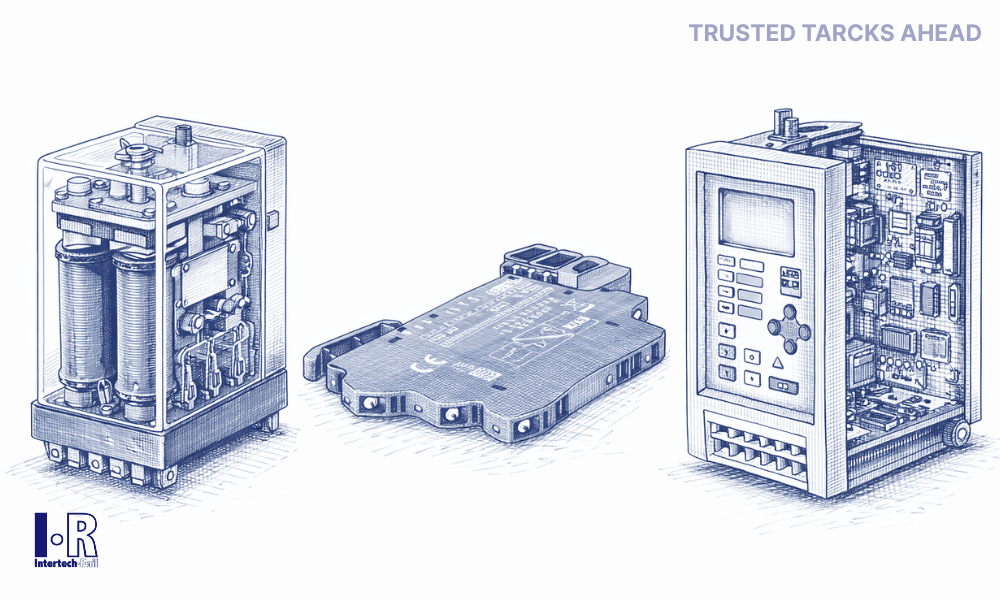
Mechanical systems offer visible logic and predictable failure modes. Electronic solutions offer speed and compactness. Digital platforms offer configurability and analytics.
In practice, hybrid architectures dominate. Conservative relay assemblies similar to those still deployed in high-integrity signaling environments, including solutions supported by Intertech Rail, often coexist with digital supervision layers.
Technology in railways does not advance by erasing its past. It accumulates.
Share article