AI-Powered Yard Dispatch & Decision Support
How Can AI-Powered Decision Support Improve Rail Yard Dispatch and Train Make-Up?
The Complexity of Yard Dispatch Decisions
No two rail yards operate the same way. On some days everything follows the schedule. On others, a delayed inbound train, an unavailable locomotive, or a last-minute customer request changes the plan within minutes. That's why yard dispatching is rarely as simple as following a timetable.
Most dispatchers already have plenty of information available. The difficult part is figuring out which pieces deserve immediate attention before small problems grow into bigger ones.
What Does a Yard Dispatcher Decide Every Day?
Throughout a shift, dispatchers constantly adjust priorities to keep cars moving without compromising safety or slowing down the overall operation.
Track Assignments for Arrivals and Departures
An arriving train may need a receiving track immediately, while another can wait without affecting the operation. Meanwhile, departure tracks have to stay available so outbound trains can leave on time without creating extra switching work later.
A track assignment that looks reasonable in the moment can easily become tomorrow's bottleneck—or even the next hour's.
Car Classification and Train Make-Up Priorities
Building an outbound train involves much more than grouping cars by destination. Service commitments, hazardous material rules, weight distribution, train length, and customer priorities all have to fit together.
When several departures are being prepared at once, priorities can shift very quickly, leaving dispatchers only a short window to adjust the operating plan.
Why Are Traditional Dispatch Methods Limited?
Experience helps dispatchers recognize patterns and make good decisions under pressure. Still, no one can keep track of every movement, every constraint, and every possible consequence at the same time.
Manual Information Gathering and Verbal Coordination
In many yards, important information is still exchanged over the radio, written on paper, or spread across different software systems. Pulling everything together takes time.
And in a busy yard, conditions can change before everyone is even looking at the same information.
Limited Visibility of Future Conflicts and Bottlenecks
Human operators naturally focus on solving the immediate problem.
Predicting how today's track assignment might create congestion forty minutes later is much more difficult, particularly during heavy traffic periods.
AI-Powered Decision Support in Rail Yards
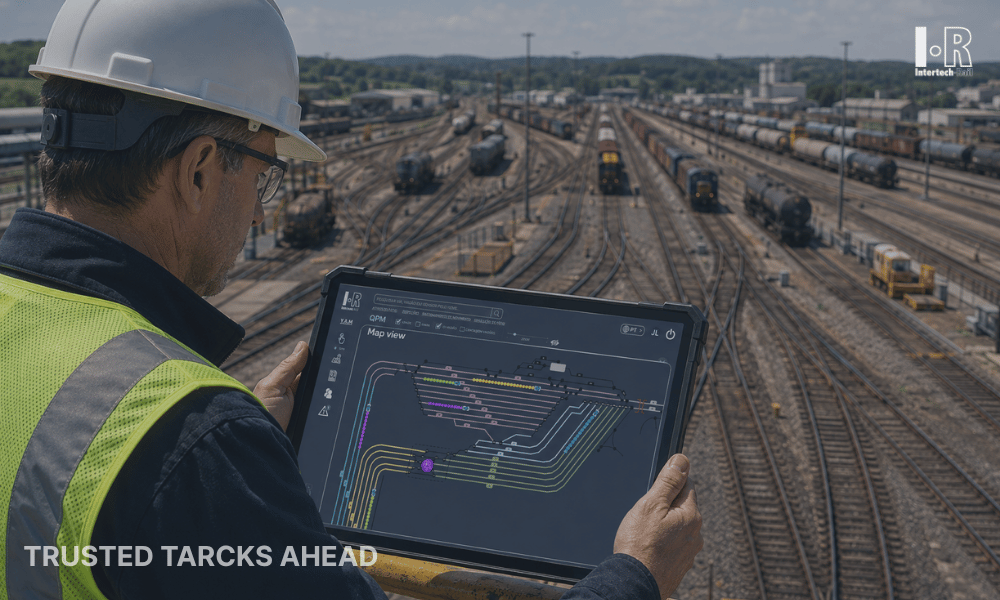
This is where AI starts to make a real difference. It doesn't replace the dispatcher's experience. Instead, it quickly compares thousands of possible operating scenarios and highlights options that would take far longer to evaluate manually.
What Is an AI Decision Support System for Yard Operations?
An AI decision support platform analyzes live operational data and proposes actions that fit established operating rules while adapting to changing yard conditions.
The final decision remains with the dispatcher.
Engine That Suggests Track Assignments and Switch Plans
Instead of generating a fixed dispatch sequence, the system continuously recalculates recommendations as trains arrive, cars move, or track availability changes.
Rules and Constraints Based on Real Operating Practices
Recommendations respect speed restrictions, switching limitations, safety procedures, maintenance activities, hazardous cargo separation, locomotive availability, and local operating practices.
That makes the suggestions practical rather than theoretical.
What Inputs Does AI Need to Suggest Better Decisions?
High-quality recommendations depend entirely on reliable operational data.
Car Location and Status from Rail-ID® / AEI
Real-time identification from Rail-ID® and AEI systems provides accurate car locations, movement history, and equipment status, reducing uncertainty during train assembly.
Train Schedules, Service Commitments, and Customer Priorities
The system evaluates departure schedules alongside contractual delivery requirements so that critical traffic receives appropriate attention when conflicts occur.
Track Capacity, Maintenance Windows, and Safety Rules
Track availability is constantly updated to reflect maintenance activities, temporary restrictions, occupied tracks, and operational safety rules before recommendations are generated.
Practical Use Cases for AI in Yard Dispatch
The greatest value often comes from reducing small operational mistakes that accumulate throughout the day.
How Can AI Help Build Trains Faster and With Fewer Errors?
Small improvements during classification frequently eliminate larger delays later.
Automatic Check for Misplaced Cars Before Departure
Before a train leaves the yard, the system verifies whether every car is positioned in the correct consist, reducing rework and avoiding unnecessary departures with incorrect train make-up.
Suggesting Optimal Car Ordering for Service and Weight Limits
AI can recommend car sequences that satisfy service priorities while respecting weight distribution, train length, and operational restrictions.
How Does AI Help Prevent Yard Congestion?
Congestion usually develops gradually rather than all at once.
Early Warning When Tracks Approach Capacity
By monitoring occupancy trends, AI identifies tracks likely to reach capacity before operations become constrained, allowing dispatchers to intervene earlier.
Recommending Alternative Track Plans for Peak Periods
The system can evaluate multiple routing options and suggest alternative switching plans that distribute traffic more evenly across available infrastructure.
Adoption and Change Management
Technology succeeds only when operators trust the recommendations it produces.
How Should Railroads Introduce AI Support to Yard Teams?
Successful implementations generally begin by supporting existing dispatch decisions instead of replacing them.
Start with Advisory Mode Before Automated Execution
Advisory mode allows dispatchers to compare recommendations with their own experience, building confidence before introducing higher levels of automation.
Training, Feedback Loops, and Human-in-the-Loop Control
Continuous operator feedback helps refine recommendation models while ensuring that experienced personnel remain responsible for final operational decisions. In practice, the strongest AI systems are those that complement dispatcher expertise rather than attempt to replace it.
GO DEEPER ON THESE TRACKS: AI-powered dispatch depends on accurate operational data, connected systems, and secure digital platforms. Explore What Is a Rail Yard Digital Twin and How Can It Improve Freight Operations? to learn how virtual yard models improve operational visibility, discover How Should Rail Yards Integrate Rail-ID® and AEI Data with ERP, TMS, and Billing Systems? for guidance on enterprise data connectivity, and review How Can Rail Operators Protect Yard Automation and AEI Systems from Cybersecurity Threats? to understand how cybersecurity supports reliable AI-driven rail operations. These related articles are already published or will be available soon.
What is Asset Visibility, and how does it work?
Asset visibility refers to the ability to monitor the location, condition, status, and utilization of physical assets across an operation. In rail environments, this includes rolling stock, maintenance equipment, containers, and other critical resources. Data is gathered automatically and consolidated into systems that provide a unified operational view.
Why is Asset Visibility important for modern railway operations, and what challenges can it solve, and what benefits does it provide?
Without reliable asset visibility, organizations often struggle with asset utilization, inventory control, and operational planning. Improved visibility helps reduce uncertainty, improve resource allocation, support maintenance activities, and provide stakeholders with accurate information about asset availability and operational status.
What technologies are commonly associated with Asset Visibility?
Asset visibility programs often combine RFID, AEI, GPS tracking, condition monitoring systems, IoT sensors, enterprise software, analytics platforms, and operational dashboards. Integrating multiple data sources allows organizations to gain a more complete understanding of asset performance and utilization.
What Intertech Rail solutions are available for Asset Visibility?
Intertech Rail provides identification, tracking, and data management solutions that support asset visibility initiatives. Through the Rail-ID® ecosystem, operators can capture movement events, maintain asset records, and improve access to operational data across railway networks and facilities.
Share article