Interoperability and Standardization: The Role of Fail-Safe Relays in Cross-Border Railway Networks
How fail-safe principles enable safe and seamless integration between diverse signaling systems
Interoperability in railway networks is rarely achieved solely through design. In most cases, it emerges from the need to connect systems that were developed independently, under different rules and assumptions. When trains cross borders, signaling systems must interact in ways that were not originally planned.
In this context, interoperability and standardization depend less on uniform technology and more on predictable safety behavior at system boundaries. Fail-safe principles, particularly those implemented through relay-based logic, provide that predictability.
The Challenge of Railway Interoperability
Legacy national standards and fragmented infrastructures
Railway signaling systems evolved within national frameworks. Operating rules, technical standards, and safety philosophies were developed in parallel rather than together. As a result, cross-border corridors often connect infrastructures with limited inherent compatibility. Integration, therefore, becomes an operational challenge, not just a technical one.
Differences in signaling logic, voltages, and operating rules
Signaling logic, voltage levels, and control rules vary significantly between countries. These differences complicate interfaces, especially under degraded or abnormal conditions. Without a common safety reference, system boundaries become points of elevated risk.
Operational barriers to cross-border traffic
From an operational perspective, these differences often result in speed reductions, increased procedural controls, or system changes at borders. Each measure reduces efficiency and increases complexity.
The European approach to harmonization
European railways addressed interoperability through gradual alignment rather than immediate replacement of national systems. This approach acknowledged long transition periods where multiple systems would coexist.
ERTMS objectives and the role of ETCS
ERTMS, with ETCS at its core, establishes a shared framework for train control across borders. However, national signaling systems continue to operate alongside ETCS, particularly during migration phases.
Interfaces, therefore, remain critical.
Establishing a shared safety philosophy
Beyond technical specifications, harmonization requires agreement on how systems behave when conditions are not ideal. Fail-safe principles provide a common safety foundation across different national approaches.
Fail-Safe Relays as an Interface Between Systems
Technology-agnostic safety enforcement
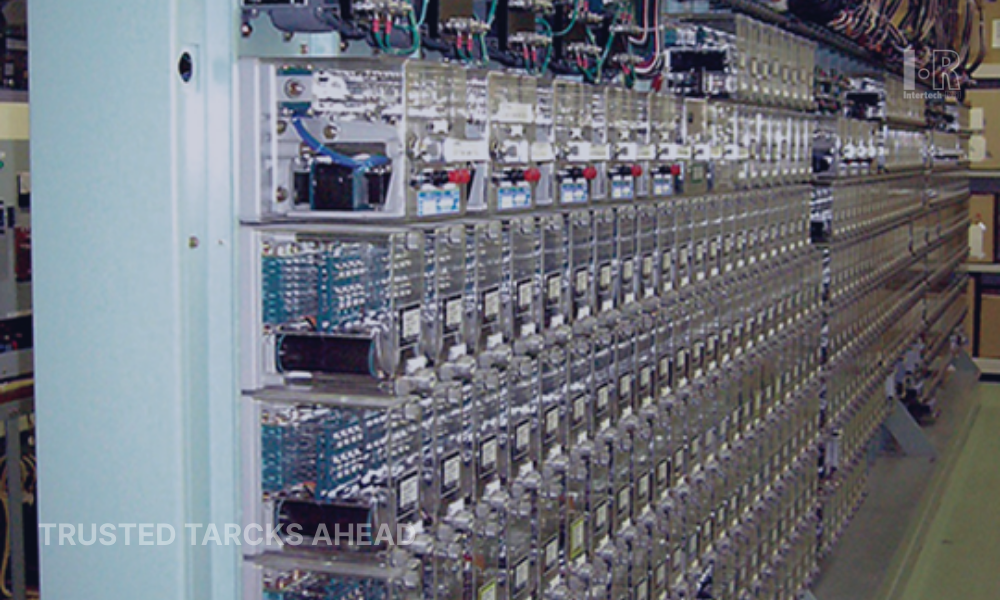
Fail-safe relays operate independently of software platforms, data protocols, and communication layers. This makes them well-suited for environments where diverse technologies coexist.
Relays as a common safety language across systems
At system interfaces, relays act as a shared safety language. Their behavior is understood regardless of the upstream or downstream signaling technology, simplifying integration and reducing ambiguity.
Managing system boundaries and interfaces
System boundaries are where most interoperability risks concentrate. Information may be delayed, incomplete, or inconsistent.
Fail-safe relay-based interfaces define clear acceptance rules and predictable responses, particularly when inputs are missing or conflicting.
Fail-safe fallback mechanisms in mixed environments
In mixed signaling environments, fallback behavior is essential. Fail-safe relays provide deterministic fallback states that do not rely on complex logic or external communication.
Ensuring Safety in Multi-System Operations
Relays in interface and transition zones
Transition zones between signaling systems require controlled behavior. Trains move between different control logics, often without stopping.
Fail-safe relays help manage these transitions by enforcing boundary conditions that remain valid regardless of the controlling system.
Enforcing safety rules at national and technical borders
At both national and technical borders, fail-safe relay logic enforces safety rules consistently. This reduces dependence on procedural controls and manual intervention, supporting safer cross-border railway operations.
Interoperability in railway signaling is ultimately about managing differences without increasing risk. Fail-safe relays contribute by providing stable, technology-independent safety enforcement at system boundaries, supporting reliable operation across diverse signaling environments.
Share article